Mathematical Engineering · İstanbul Technical University

Ömer Kahyaoğlu

Mathematical Engineer · Mathematics of AI

I study the mathematics that makes learning systems work: estimation, low-rank structure, optimal transport and the statistics of evaluation. My goal is to help build the mathematical core of artificial intelligence, the part where the raw material is processed.

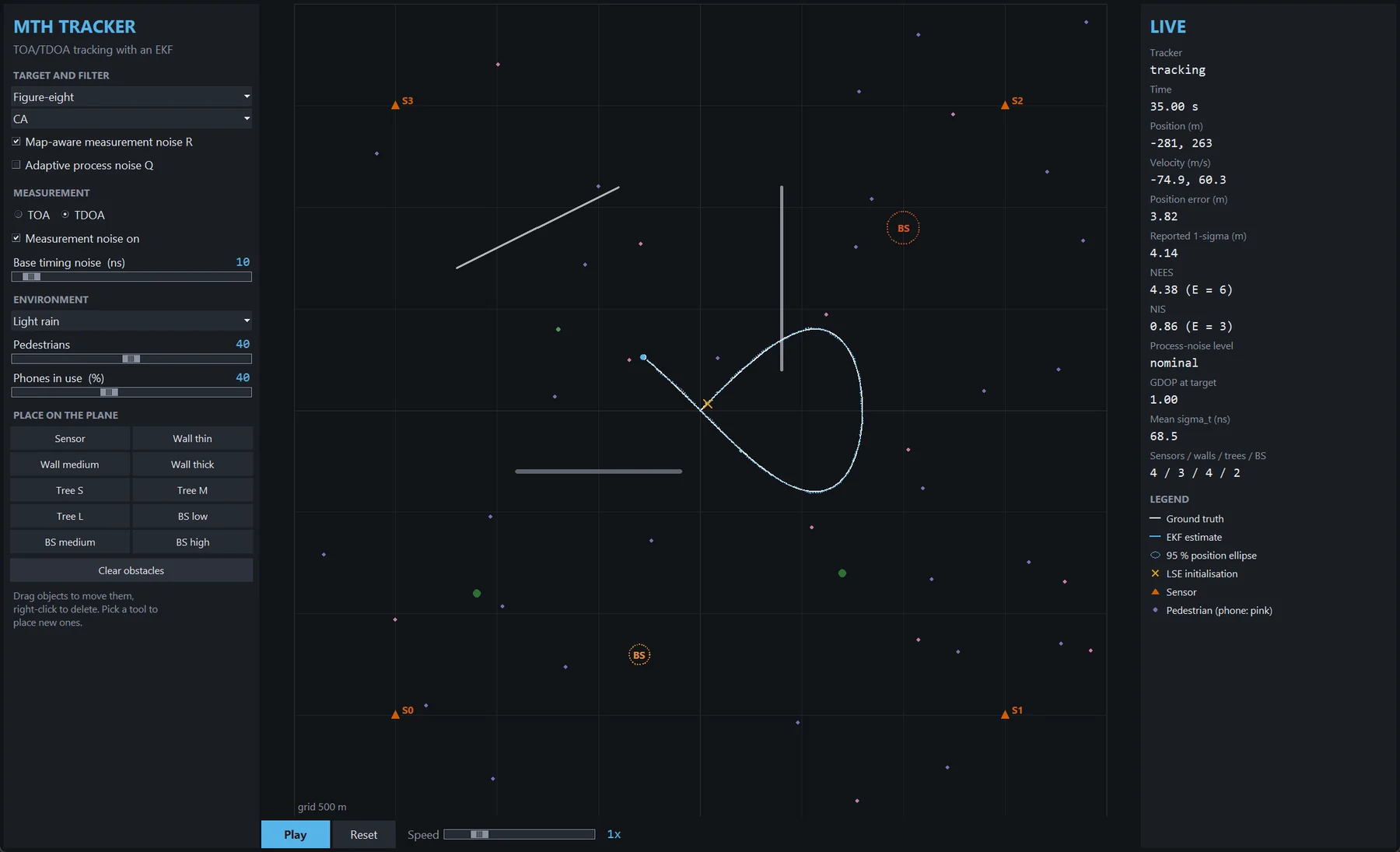
Robust PCA separates a slowly changing background from sparse moving targets. My absorption analysis asks what happens when a target stops.
2journal manuscripts in preparationIEEE SPL · JMLR
5open research codebasesPython · MATLAB · Lean 4
0hand-typed numbers in my manuscriptsevery figure and table is script-generated
7years at ITUelectronics → mathematics
01 / About

From microchips to the mathematics of learning

Who I am, why I changed course, and where I am going.

I came to İstanbul Technical University in 2020 to study Electronics and Communication Engineering, with a career in microchip design in mind. Four years and 169 ECTS later I made a deliberate lateral move into Mathematical Engineering. Hardware had taught me how computation is executed; I wanted to understand why the algorithms running on it work at all.

That question has driven everything since. Moving across was about unravelling the mathematics behind artificial intelligence: what a neural network is as a function, why gradient descent finds anything, how a language model turns statistics into fluency, and how we can tell, with stated confidence, whether one model really is better than another.

I am now in my seventh and final year at ITU, completing my last two terms and my graduation project. My electronics years left me with a systems view of CPUs, GPUs and memory hierarchies, which I bring to every algorithm I write.

Next, I want to dedicate myself to the mathematics of AI through a Master's and a PhD, and alongside that to start a research-driven venture or join a research team that designs the mathematical and architectural foundations of AI systems.
01

Every number has a script

No result in my reports is typed by hand. Each table, figure and quoted value is regenerated by one command from stored artifacts, and tests check the papers against them.

02

Protocols before results

Evaluation protocols, data splits and acceptance criteria are written down before the runs they govern; deviations are logged as dated decisions.

03

Proofs that compile

Where an argument can be formalised, I formalise it. certgen's formal statements are proved in Lean 4 with their axioms pinned at build time.

04

Negative results stay in

Experiment registries record failed and exploratory runs too, and my research repositories document their limitations.

05

AI as an instrument, me in the loop

I use large language models deliberately, as research and writing instruments under a human-in-the-loop verification workflow that checks every claim they help produce.

02 / Research

Manuscripts in preparation

Two single-author manuscripts, each released with the complete code, raw results and the scripts that regenerate every number, table and figure.

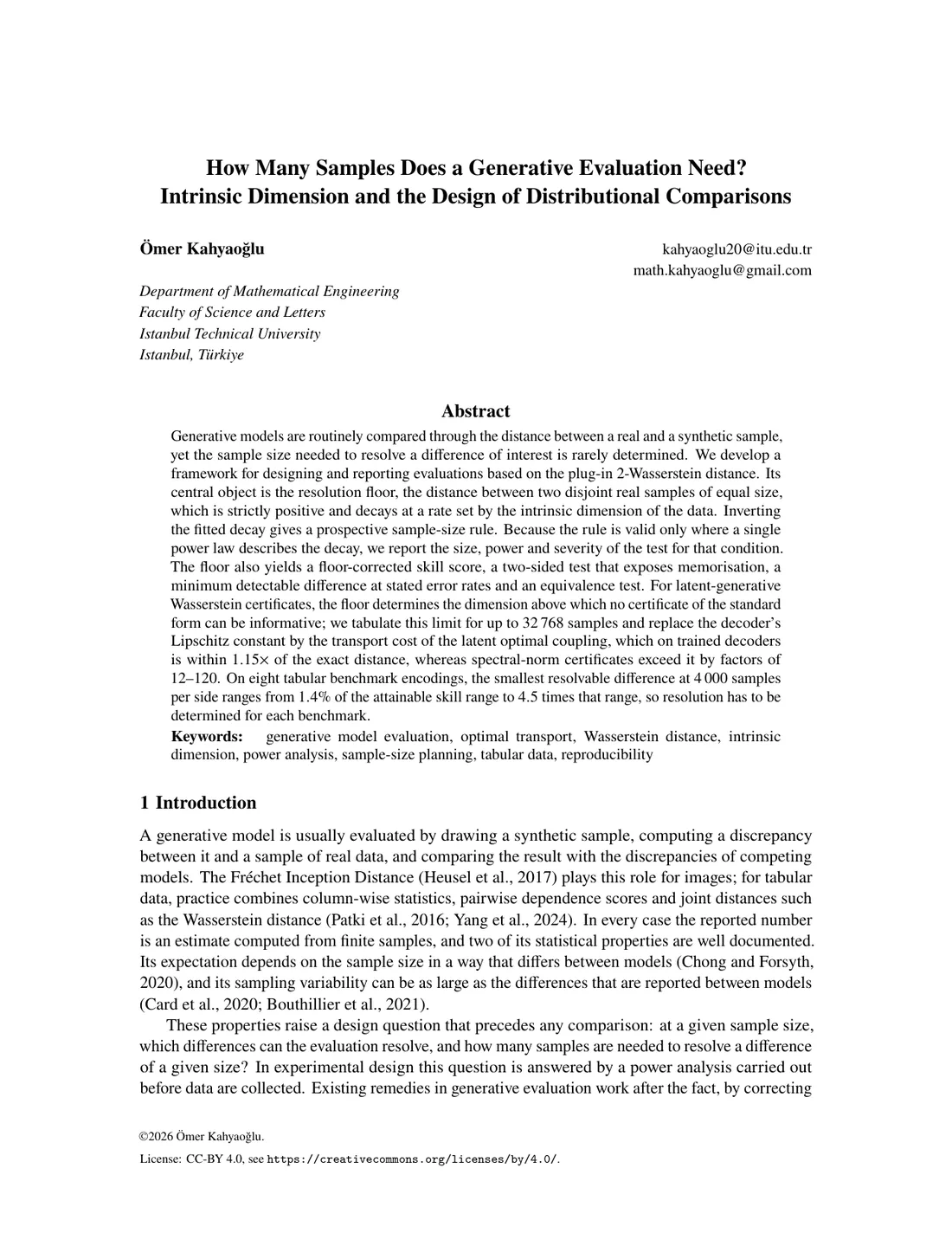
First page of the manuscript
Preprint · in preparation for JMLRGraduation project · 2026

How Many Samples Does a Generative Evaluation Need?

Two independent real samples are already at a positive W₂ distance. certgen measures this resolution floor before any model is trained and turns it into a sample-size rule, a floor-corrected skill score and a certification limit.

≤ 1.15×plan-pullback bound vs exact W₂ on trained decoders
12–120×over-estimate of spectral-norm certificates
32 768largest sample size of the reference tables
8tabular benchmark encodings studied
Optimal transportWasserstein distanceIntrinsic dimensionPower analysisLean 4Python
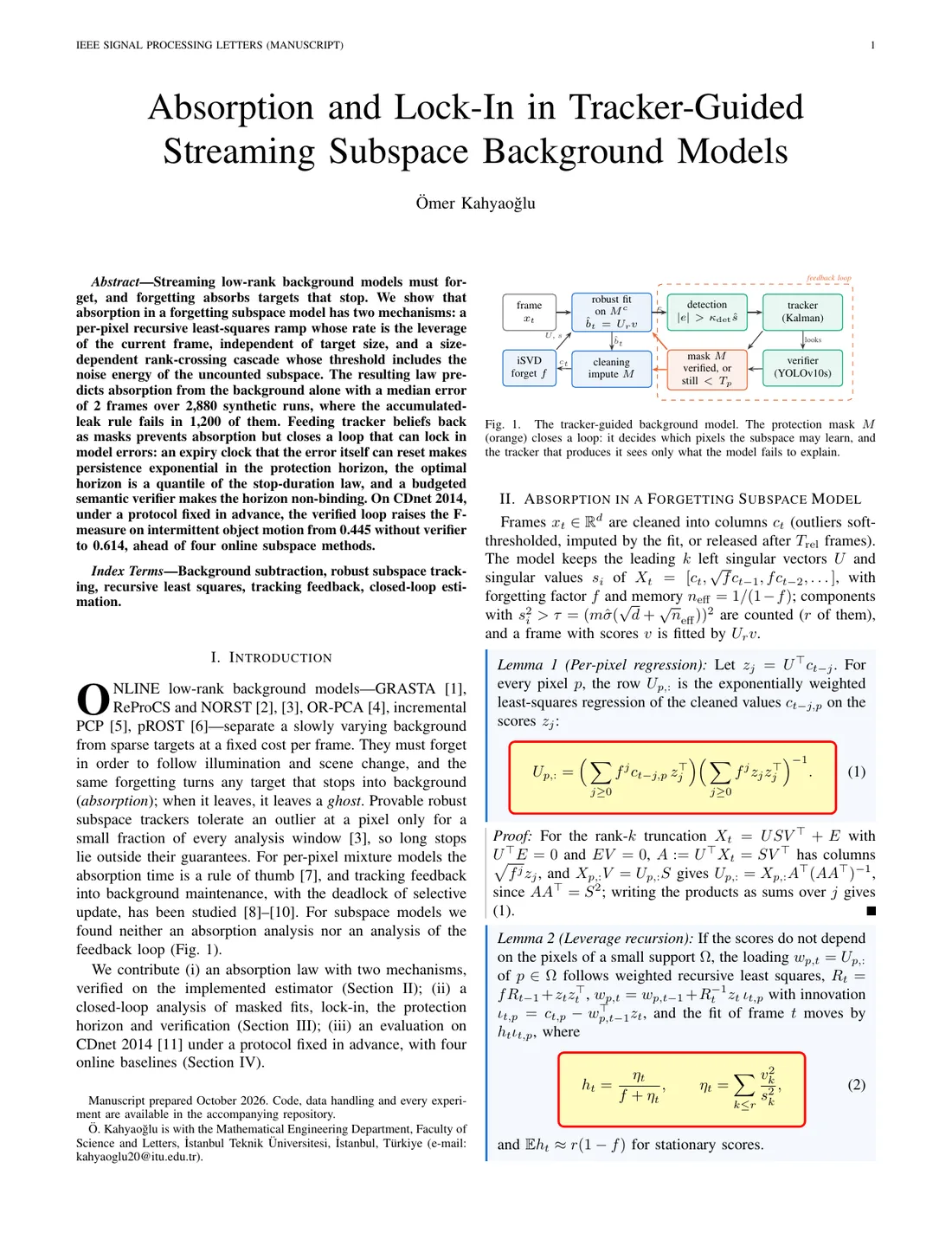
First page of the manuscript
Preprint · in preparation for IEEE SPLIndependent research · 2026

Absorption and Lock-In in Tracker-Guided Streaming Subspace Background Models

An absorption law for forgetting subspace models, a closed-loop analysis of tracker feedback, and a pre-registered CDnet 2014 evaluation with four online RPCA baselines, shipped with a real-time operator console.

2 framesmedian error of the absorption law (2 880 runs)
0.614IOM F-measure of the verified loop (vs 0.445)
4online subspace baselines on the same frames
8.3 msper frame on one desktop core, no verifier
Robust PCASubspace trackingRecursive least squaresKalman filterComputer visionPythonMATLAB
Work in progress. Both manuscripts are preprints that have not yet been peer-reviewed or reviewed by my advisor. Methods, results and wording may change before submission.
03 / Projects

Projects and course work

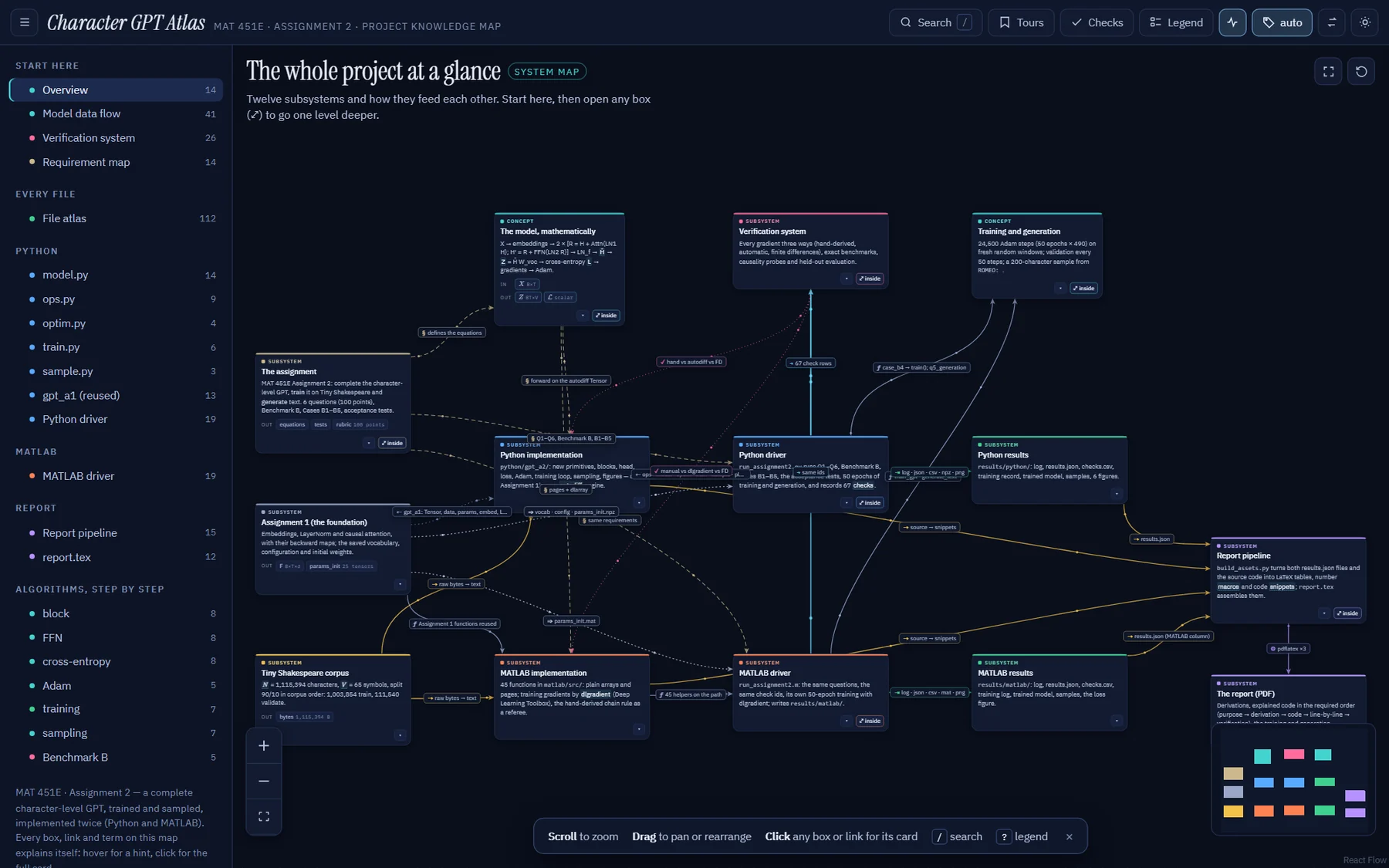
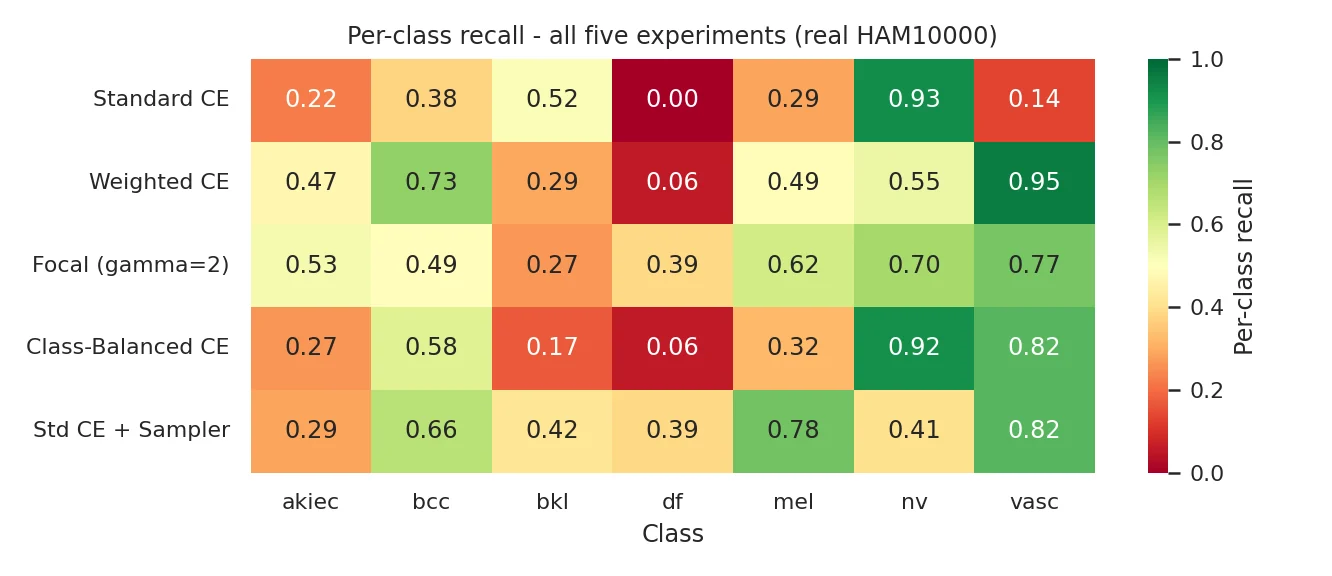
Software I designed, tested and documented: estimation and tracking, a GPT built from first principles, and a controlled study of class imbalance.

Character GPT
Course project · MAT 451E

Character-level GPT from scratch

Residual blocks, GELU FFN, causal attention, stable cross-entropy and Adam, written twice (Python and MATLAB), trained 50 epochs on Tiny Shakespeare. Both implementations pass 67/67 verification checks.

1.634validation loss, nats/char (perplexity 5.12)
67 / 67verification checks pass in both languages
04 / Notes & other work

LaTeX self-study lecture documents

A personal and educational project: turning lecture notes into structured, typeset course documents.

Alongside the projects above, I run a long-term personal and educational project: turning academics' lecture notes, handwritten pages and scattered material into structured digital documents typeset in LaTeX, for almost every course I have taken.

The work rests on prompt engineering and precise control of large language models. I have developed a pipeline that drives the models to produce publication-quality LaTeX with mathematical precision, and a human-in-the-loop review that checks every definition, derivation and example before a document is considered finished.

Real & complex analysisDifferential equationsLinear algebra & matrix theoryProbability & statisticsNumerical methodsNumerical optimisationFunctional analysisDifferential geometryModern algebra
CaptureHandwritten notes, board photos and lecture slides are collected per course and per week.
StructureMaterial is reorganised into definitions, theorems, proofs, worked examples and exercises.
TypesetA prompt-engineered LLM pipeline writes consistent, compilable LaTeX in a shared house style.
VerifyI review every derivation and example by hand; corrections feed back into the prompts.

Linear Algebra & Genetics learning module

Team leader and main presenter · ITU · Dec 2025

Led a five-person team that designed a university-level learning station teaching genetic inheritance through matrix operations. The project received a perfect score for mathematical accuracy, pedagogy and interdisciplinary integration.

Computational Linear Algebra group projects

Team member · ITU

Group projects in computational linear algebra and matrix methods, where I contributed as one member of the team.

Homework and self-study documents

Ongoing

Carefully written problem sets and self-prepared study PDFs across the curriculum, smaller in scope than the projects above. Available on request.

05 / Curriculum vitae

Education and experience

The short version is below; the full CV is available as a PDF.

Education

  • B.Sc. Mathematical Engineeringİstanbul Technical University

    Final year; expected graduation summer 2027. Graduation project on the design of evaluations for generative models (certgen). Coursework spans real and complex analysis, ODEs and PDEs, functional analysis, differential geometry, probability and statistics, modern algebra, computational linear algebra, numerical methods and optimisation.

  • Electronics and Communication Engineeringİstanbul Technical University

    169 ECTS completed before transferring to Mathematical Engineering. Circuit and system analysis, digital systems, semiconductor devices, computer architecture and the hardware–software interface.

  • High school diplomaKadıköy Anatolian High School

    Graduated with 95.36 / 100 and the Student of Honour distinction, from one of Türkiye's most selective public high schools.

Experience

  • Guest presenterİstanbul University, Cerrahpaşa Faculty of Medicine

    Invited 75-minute talk, “GPT-4 and the Future of AI in Healthcare Diagnostics”, to more than 50 medical students, faculty and clinical researchers.

  • Operations internArttech Defense, İstanbul

    Digital documentation systems and workflow analysis in a high-security defence-industry environment.

  • Mechanical team assistant captainKAL Robotics · FIRST Robotics Competition

    Co-led mechanical design and manufacturing for FRC 2019; the team received the Innovation in Control award.

Mathematics

  • Linear algebra & matrix theory
  • Probability & statistics
  • Optimisation
  • Estimation & filtering
  • Optimal transport
  • Real & functional analysis

Programming

  • Python · NumPy · SciPy · PyTorch
  • MATLAB
  • C
  • LaTeX
  • Lean 4
  • Git

Machine learning

  • Deep learning architectures
  • Transformers & LLMs
  • Generative-model evaluation
  • Computer vision
  • Prompt engineering
  • AI-assisted research workflows

Systems

  • Computer architecture
  • CPU / GPU computing
  • Memory hierarchies
  • Hardware-aware ML
  • Circuits & signals
TurkishNative
EnglishAdvanced · C1 (IELTS 6.5)
GermanElementary · A2
Download full CV (PDF)
06 / Contact

Let's talk about the mathematics of AI.

I am looking for graduate positions, research collaborations and teams working on the foundations of machine learning. I am happy to share code, data or notes on request.

math.kahyaoglu@gmail.com